
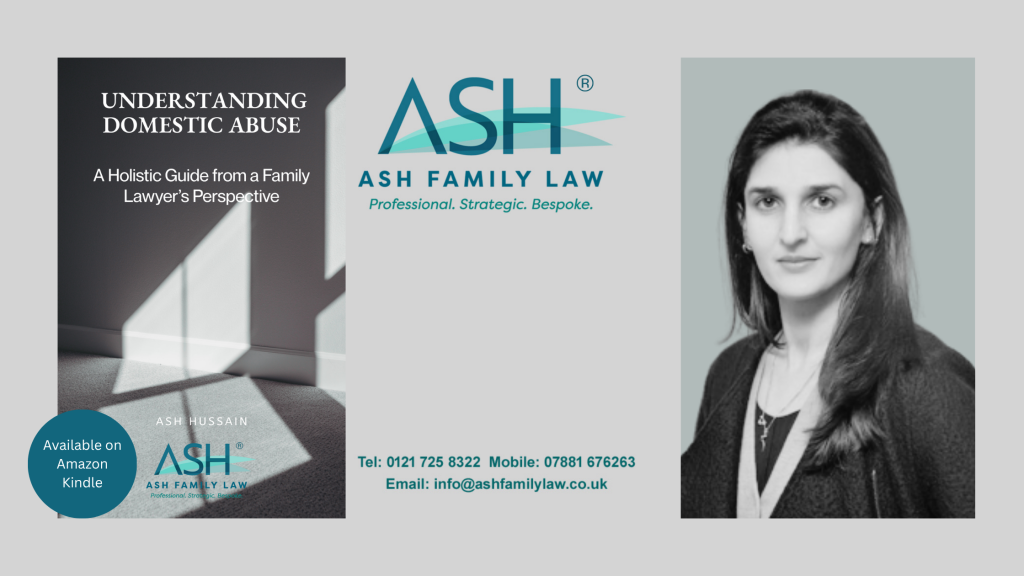
Understanding Domestic Abuse: The Patterns We Need to Recognise
When people hear the words domestic abuse, many still think first of physical violence.
But domestic abuse does not always leave a visible injury.
It can be a bank account you cannot access. A phone that is constantly checked. A partner who wants to know where you are at all times. Repeated criticism that gradually undermines your confidence. Isolation from friends and family. Technology used to monitor your movements. Or simply reaching the point where your decisions are governed by one question:
“What will happen if I do this?”
That shift from freedom to fear is important.
In my book, Understanding Domestic Abuse: A Holistic Guide from a Family Lawyer’s Perspective, I explore domestic abuse not simply as a series of incidents, but as patterns of behaviour that can affect virtually every area of a person’s life.
Here are some of the key themes.
Domestic abuse is more common than many realise
The scale of domestic abuse remains significant.
Domestic abuse frequently happens behind closed doors. It may develop gradually, and a victim-survivor may struggle for months or years to identify what they are experiencing as abuse.
That is why understanding the behaviours behind the statistics is so important.
Coercive control can create an invisible cage
Coercive control is rarely about one disagreement, one argument or one unreasonable request.
It is the wider pattern that matters.
A partner might monitor communications, restrict access to money, isolate someone from friends and family, control their appearance or routines, track their location, interfere with employment or use children and finances as a means of pressure.
The warning comes when concern becomes expectation, expectation becomes restriction, and restriction is reinforced by anger, intimidation, punishment or fear.
Healthy relationships involve compromise.
Control is different.
Money can become a means of control
Financial and economic abuse can be particularly difficult to recognise because financial arrangements are a normal part of relationships.
There is nothing inherently abusive about one person managing the household finances.
The problem arises when responsibility becomes exclusive control.
A person may find that they cannot access bank accounts, do not know where assets are held, have to justify everyday spending or are prevented from working.
Debt may be accumulated in their name. Assets may be hidden. Employment may be disrupted. Financial information may deliberately be withheld.
And the consequences can continue long after separation.
Without economic independence, the question “Why don’t they just leave?” fails to recognise a fundamental problem:
How do you leave when you have nowhere to go and no money with which to get there?
Separation does not necessarily end abuse
Leaving an abusive relationship is often spoken about as the solution.
Unfortunately, separation can sometimes change the risk rather than immediately end it.
When a perpetrator believes they are losing control, behaviour may intensify.
Persistent unwanted contact, stalking, harassment, property damage, threats, online abuse and attempts to interfere with employment, housing or finances can all occur after a relationship ends.
Children and legal proceedings can also, in some circumstances, become another route through which pressure is maintained.
Technology has changed what abuse can look like
A perpetrator no longer needs to be physically present to exert control.
Smartphones, GPS tracking, social media, cloud accounts, online banking, doorbell cameras, smart-home systems and connected devices have created new opportunities for monitoring and harassment.
Technology-facilitated abuse can include accessing accounts, tracking someone’s location, installing spyware, monitoring purchases, impersonating someone online, publishing personal information, sharing intimate images without consent or using children’s devices to gather information about a former partner.
For a victim-survivor, this can create the frightening impression that there is nowhere they cannot be reached or watched.
Technology has transformed our lives.
Unfortunately, it has also transformed some of the ways control can be exercised.
Geography can create another layer of isolation
Domestic abuse in a rural community involves the same fundamental dynamics of power, control, coercion and intimidation, but geography can create additional vulnerabilities.
Imagine trying to seek help when you live miles from your nearest neighbour, public transport is limited, mobile reception is unreliable and the only available vehicle is controlled by your partner.
Now add a close-knit community where everyone knows everyone else.
The concern may not simply be that somebody will find out.
It may be that everybody will find out.
For those whose home, employment and finances are also connected to a family farm or rural business, leaving can mean potentially losing a relationship, home, livelihood and community simultaneously.
It demonstrates why advice about domestic abuse cannot take a one-size-fits-all approach.
Recovery does not begin and end with leaving
Safety matters enormously.
But reaching safety does not automatically undo the psychological and physical effects of prolonged abuse.
Someone who has spent months or years anticipating another person’s mood may remain hypervigilant long afterwards.
They may struggle to sleep, make decisions or trust their own judgement. A particular tone of voice, message notification or disagreement may provoke a powerful reaction even when the immediate danger has passed.
Recovery therefore involves more than telling someone to “move on”.
It may mean gradually rebuilding confidence, independence, identity, relationships and trust in their own decisions.
There is no correct timetable for that process.
Perhaps the most important lesson: look at the pattern
Throughout Understanding Domestic Abuse, one message repeatedly emerges:
Context matters. Patterns matter. Impact matters.
Not every argument is abuse.
Not every disagreement about money is economic abuse.
Not every jealous reaction amounts to coercive control.
But when behaviours repeatedly restrict another person’s independence, create fear, undermine their confidence or compel them to change the way they live to avoid another person’s reaction, we need to look beyond individual incidents.
As a family solicitor, I have seen the consequences domestic abuse can have for relationships, children, finances, safety and family life.
My understanding of the subject is also personal.
That is why I wanted this book to go beyond legal definitions. It explores the different ways abuse can manifest, how those behaviours can overlap, what can happen when control escalates, practical considerations around safety and legal protection, and the often-overlooked process of recovery.
Because sometimes understanding what is happening is the first step towards changing what happens next.
Understanding Domestic Abuse: A Holistic Guide from a Family Lawyer’s Perspective
© 2026 Ash Family Law. All rights reserved.
Disclaimer: The information provided in this blog is for general informational purposes only and does not constitute legal advice and should not be construed as legal advice. While every effort is made to ensure the accuracy and relevance of the content, laws and regulations are subject to change and may vary depending on individual circumstances and jurisdiction.
Nothing in this blog should be relied upon as a substitute for obtaining professional legal advice tailored to your specific situation. You should not act or refrain from acting based on any information contained herein without first seeking appropriate legal or other professional advice.
The author accepts no responsibility or liability for any loss or damage incurred as a result of reliance on the information provided in this blog. Views expressed are those of the author and do not necessarily reflect those of any affiliated organisations.